Loro Piana Textile Division — Application exposure landscape
A suiting cloth and an interior linen meet different rooms, different hands and different cleaning habits. Name the room before you name a favourite shade.
Application exposure landscape
Contact
Touch is the first filter for tailoring cloth. A wool twill can feel dry and clear, while a wool-silk-linen blend can feel cooler and less springy. Neither feeling predicts how the cloth will look after a season of wear. Ask who touches the surface: a jacket sleeve, a trouser seat, or an upholstery face that meets hands and clothing every day.
Care follows contact. Suiting is usually pressed and spotted rather than washed like a shirt. A linen used for a curtain may be vacuumed and occasionally cleaned by a specialist. Write the real care path. A gentle phrase on a swing ticket is not a test method, and it should not be copied from one end use onto another.
Appearance under contact includes crease, shine and pilling. Record which of those matters for this garment or this seat. A smooth wool face that shines at the elbow is a different complaint from a linen that creases by design.
Exposure
Indoor tailoring exposure is mostly humidity, body moisture and daylight through a window. Outdoor weather is a separate brief. This catalogue conversation is built around apparel cloth and home textiles. If the cloth must live in rain, say so as its own question and do not borrow a waterproof claim from another product family.
Liquid on the surface and vapour in the air still need separate notes. A rain spot on a wool shoulder is not the same observation as a jacket that feels clammy in a warm room. Linen changes hand as room humidity changes. Describe the room rather than asking for a single comfort score.
Light exposure matters for pale linen and for a pale wool used near a window. If shade stability is part of the decision, ask which method and which specimen state would be relevant. Do not treat a showroom lamp as that method.
Processing
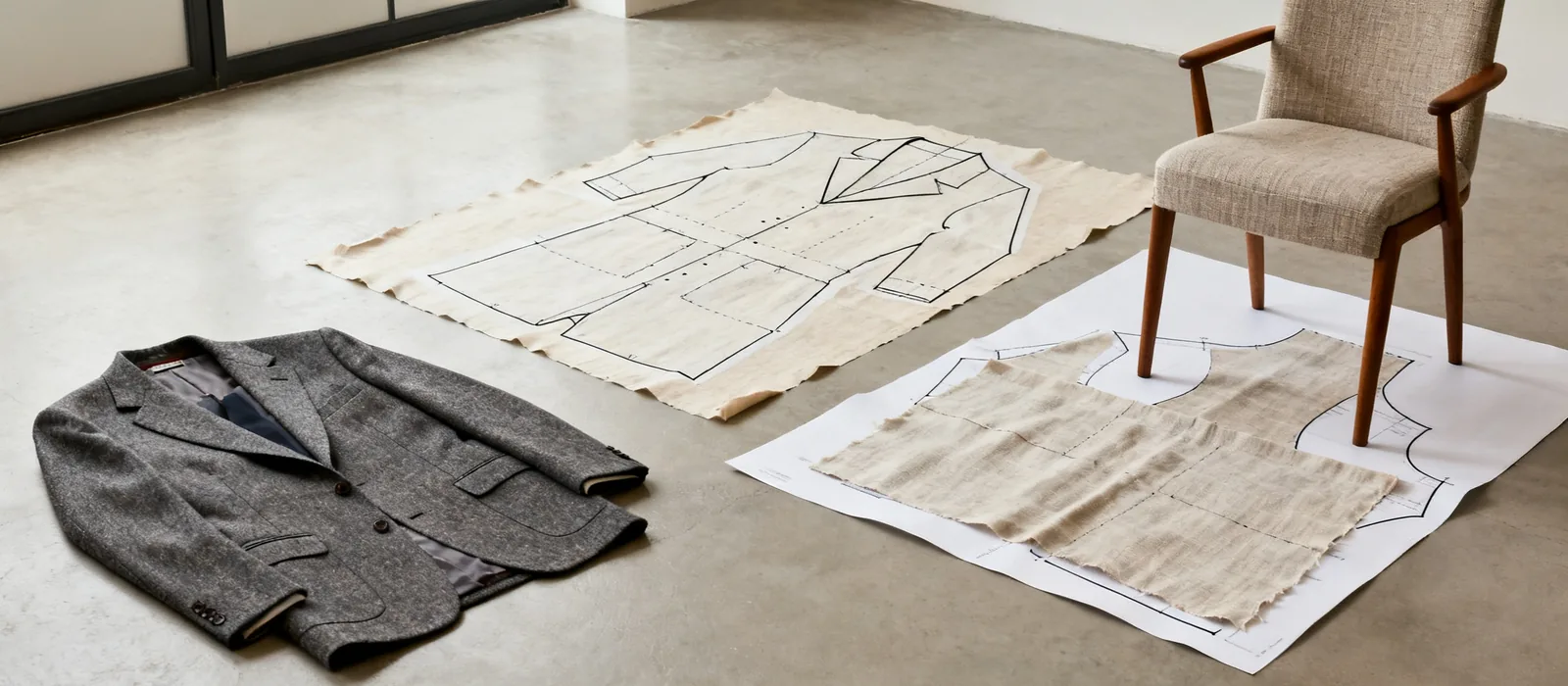
Cutting needs the usable width, not only the full width on a ticket. A narrow suiting can waste a laid pattern even when the hand is right. Mark the selvedge and say whether the pattern is a jacket, a trouser or a panel for upholstery.
Joining depends on the weave and the edge. A loose linen can slip at a seam in a way a tight wool twill does not. If you already know the stitch density or the interlining, add it. If you do not, leave the field blank instead of copying a factory default.
Pressing and finishing at the maker are part of processing too. A clear-finished wool and a softer milled wool will not take the same iron. Tell the brief which finish is already on the reference cutting so the next piece is judged against that surface, not against a photograph of a completed coat.
A review card, not a client result
Background: a jacket cloth question compares a 260 g/m² all-wool twill with a usable width of 150 cm against a 240 g/m² wool-silk-linen plain weave with a cuttable width of 148 cm. Process: the note separates a liquid spot from room humidity, keeps the shade attached to one lot card, and records composition so the percentages can be checked toward 100% by mass. Result: the wool stays in the jacket conversation if press and drape are the priority; the blend stays only if the cooler hand is the priority. Neither mass is a test report, and this site has no client outcome to attach to the card.
Natural fibre and synthetic fibre
Natural fibres, in this cloth range, are discussed for handle, moisture and pressing. Wool can feel dry and springy. Linen can feel cool and then crease. Those are selection notes, not an environmental ranking. Synthetic fibres are a different argument: strength, drying and functional processing, with any environmental conclusion limited to a named scope. This desk does not move a polyester or nylon cloth into the wool and linen list unless the enquiry names that fibre. A fibre brand name is still not a certificate.
Abrasion result and handfeel
A durability target, such as abrasion on a seating linen, needs the method, the end point and the specimen state before a number means anything. A comfort target for a jacket is the cutting in the hand: crease, shine and whether the face still feels like the approved swatch. One abrasion figure does not replace that hand check, and a pleasant hand does not predict seam slippage, tear strength or tensile strength. Pilling on a trouser seat is a third record. Hydrostatic head and coating add-on are not borrowed from outdoor cloth onto an uncoated suiting.
Fields to write beside the use, as questions rather than catalogue facts
Field
Unit or method
Boundary
Mass per unit area
g/m², with a tolerance
260 g/m² and 240 g/m² are examples in a brief, not stocked qualities
Usable width
cm, inside the selvedge
150 cm and 148 cm describe the example card, not a mill width list
Composition
% by mass
Declared fibres should be checkable to 100%; unknown percentages stay blank
Yarn linear density
Nm, tex or denier, one system only
Do not mix a wool count with a filament denier in the same cell
Shade and lot
Lot card and viewing light
A shop lamp is not a colourfastness method
Dimensional change
After the stated press or clean
Not a comfort score and not air permeability
Match the use before the material label
An application page is a way to frame the environment, the stress and the assembly question. It is not a list of completed installations. Describe contact, exposure, care and processing separately, then ask which evidence belongs to that condition.
Use conditions to separate in the brief
Condition
Question
Evidence context
Daily contact
What touch, care and surface change matter?
Physical sample and the stated care context
Moisture
Is the question liquid resistance or vapour movement?
Method and specimen conditioning
Assembly
How will the textile be cut or joined?
Construction and usable width
Colour
Which physical reference is under review?
Shade approval notes, not a screen swatch
Describe the use environment
Exposure, care and processing make the brief specific.