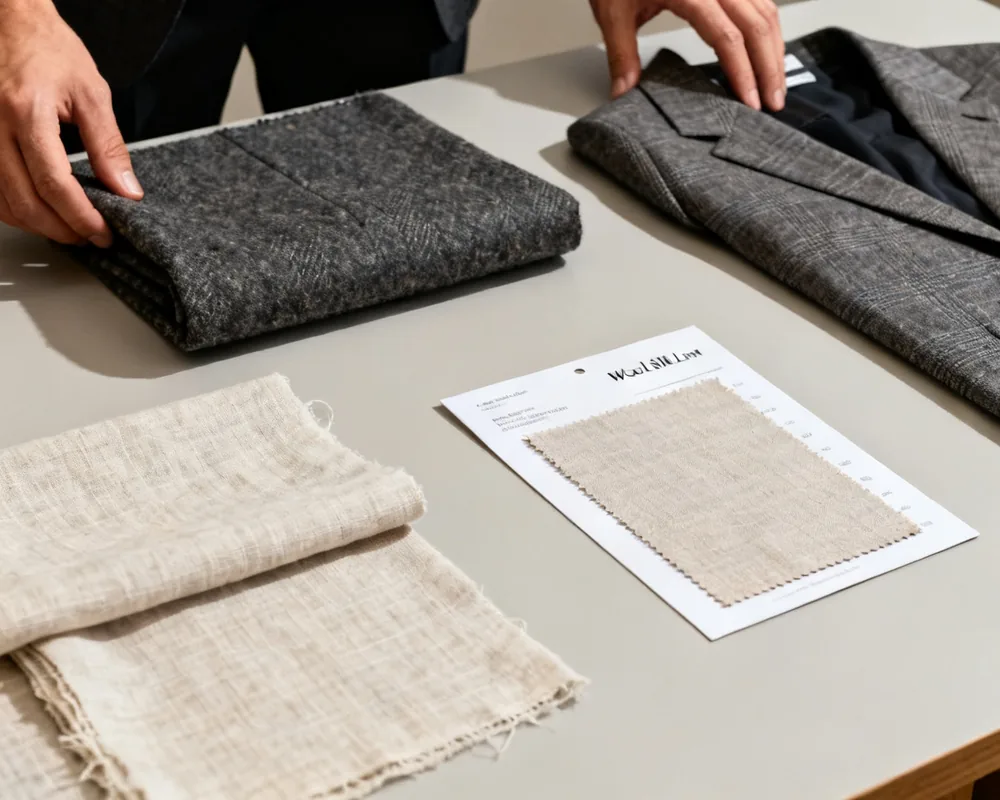
Loro Piana Textile Division — Fabric selection guide
Start with the use and the physical sample. Wool, linen, a wool-silk-linen blend and a heavier interior cloth ask for different notes even when the colour looks close on a screen.
Fabric selection guide
Begin with the setting
Describe where and how the fabric will be used before narrowing the material choice. A tailored jacket, a trouser and a seating linen do not share a winning cloth. Daily contact, expected pressing or cleaning, humidity in the room and the way panels will be joined all change the shortlist. A request for the best fabric is harder to answer than a request that names the garment or the interior piece and the one property that must not drift.
Fabric selection guide — compare at least four dimensions
Dimension
Review question
Evidence or next step
Touch
Composition alone is insufficient
Review physical handle and construction
Care
Maintenance can change suitability
Describe the actual care context
Exposure
Different stresses need different evidence
Separate water, wear and light questions
Processing
Assembly affects selection
Discuss width, edges and joining
Handle the sample as information
Images can suggest a shade direction and a visible twill or plain weave. They cannot stand in for the spring of a wool yarn or the cool drag of linen across the hand. When a cutting arrives, note the face, the back, the thickness you can feel and whether the cloth drapes in a soft column or a sharper fold. Write the construction you think you are holding, then check it against the declaration. A wool-silk-linen cloth can look quiet in a photograph and feel busier in the hand because the fibres take light differently.
Keep the intended finish on the same card. A clear wool surface and a lightly milled surface answer different jacket ideas. If the reference is only a picture of a completed coat, say so. The next cutting should answer a defined question, such as shade under daylight or crease after a press, rather than a general hope that it feels luxurious.
Compare the construction, not one label
Fibre names and grams per square metre are necessary and incomplete. Two cloths at a similar mass can differ in yarn, sett and finish. An all-wool suiting and a wool-silk-linen suiting may both be proposed for a jacket and still diverge in crease recovery, coolness and how a seam sits. Use several dimensions together: composition, weave or knit, GSM with tolerance, usable width and finish.
Ask for a method only when a performance point is actually central. Colourfastness, pilling, seam slippage and dimensional change are separate records. A buyer target is not the same field as a reported result. If the number is missing, leave it as a question. Do not fill a wool cloth brief with coating weight or membrane language that belongs to another product family.
Prepare a shortlist with tradeoffs
More than one cloth can be plausible. A drier wool may press cleanly and feel warmer. A linen may look crisp and crease in wear. A blend may sit between them and still need its own shade approval. Write the priority that wins if two properties conflict, and write what the next sample must clarify. That tradeoff is more useful than a ranking of natural against synthetic fibres, which this guide does not attempt.
Quantity and destination can sit at the end of the note. They describe the enquiry. They do not establish stock, a minimum or a ship date. Unknown company facts stay off the page: no invented output, no borrowed certificate, no claim that a fibre name equals an authorization to sell.
Specification fields
These rows are the questions a brief can carry. They are not measured results for a named quality, and they are not a price list. Roll length in metres, when it matters, is an order agreement. Yarn linear density stays in one unit system.
Key specification fields for a wool, linen or suiting enquiry
Specification
Unit
What to confirm
Mass per unit area
g/m²
Buyer target plus tolerance. A 220 g/m² linen and a 280 g/m² wool are different cloths, not a range this site stocks
Usable width
cm
Cuttable width separated from the selvedge
Composition
% by mass
Percentages that can be added toward 100, checked against the declaration
Yarn linear density
Nm, tex or denier
One system per yarn. Do not convert a wool count into denier on this page
Colour and stability
Lot and method name
Shade band, colourfastness and dimensional stability only with the specimen state
Stock cloth and a new development
Stock selection asks whether a shade lot is actually on hand, whether the same lot can be repeated, and what date that stock note refers to. This site does not publish inventory. Custom development asks for a sample, a trial and a bulk approval before a change is treated as agreed. A minimum quantity and a lead time are unknown here. Writing them as if they were published would invent a commercial term.
Coating and lamination are a separate tradeoff and usually the wrong vocabulary for an uncoated wool or linen. A coated face needs add-on, adhesion and softness. A laminated construction needs the film, peel behaviour and the specimen state. If the enquiry is a dry suiting, leave those fields unused rather than copying an outdoor cloth specification.
A repeatable check, when a number is later supplied, is the method name, the condition of the specimen, the reported figure and the lot it belongs to. This page does not publish a laboratory protocol. The practical route is a physical cutting reviewed against that written set, with the open fields sent as questions. No competing mill is scored here. The comparison is between cloth decisions: fibre, mass, width, finish, hand and the test that actually matches the use.
Use this page to prepare a question, not to supply a measured result. Write the known material reference first, then the decision that is still open. Method, specimen and scope stay attached to any figure that is already in hand. Unknown points stay questions.
Notes to keep with the page
Note
Write this
Leave this open
Material
Composition, construction and finish if known
Any value that has not been confirmed
Decision
The comparison or approval the inquiry needs
A conclusion the record does not support
Evidence
Method, specimen and scope when a report exists
A label used without that context
Next step
The sample or document that would resolve the question